

The Definitive Guide to Producing Natural-Sounding Executive Fireside Chats
This article offers a comprehensive methodology for producing executive fireside chats that feel natural and genuine. Aimed at communications directors, event organizers, and business leaders, it details operational processes, key KPIs such as Net Promoter Score (NPS) and engagement rate, and step-by-step guides to transforming a scripted interview into an authentic conversation that connects with the audience. The value proposition lies in a measurable approach to improving leadership perception, strengthening corporate culture, and achieving business objectives through effective communication. The goal is to demystify the process of **producing natural executive fireside chats**, transforming it into a replicable and optimizable science.
Introduction
In today’s corporate communication landscape, authenticity has become the most valuable currency. Audiences—whether employees, investors, or customers—are weary of polished presentations and predictable corporate speeches. They crave a genuine connection with organizational leaders. This is where the “fireside chat” format shines, offering a powerful vehicle for direct, human communication. However, the biggest challenge lies in its execution. A fireside chat that feels forced or overly scripted can be more damaging than a traditional presentation. Therefore, mastering the art and science of producing natural executive fireside chats is a critical skill. This format, when produced correctly, can break down barriers, build trust, and convey complex messages in a memorable and personal way.
This guide presents a comprehensive methodology that addresses every facet of production, from initial strategy to post-event analysis. The approach focuses on auditable processes and quantifiable metrics to ensure that “naturalness” is not a matter of luck, but rather the result of meticulous planning and flawless execution. We will measure success through a set of Key Performance Indicators (KPIs), including Audience Engagement Rate (questions, comments), the event’s Net Promoter Score (NPS), retention of key messages (measured with post-session surveys), and the impact on business metrics such as employee morale and investor confidence. The goal is to transform a simple interview into a strategic communication experience that generates tangible results.
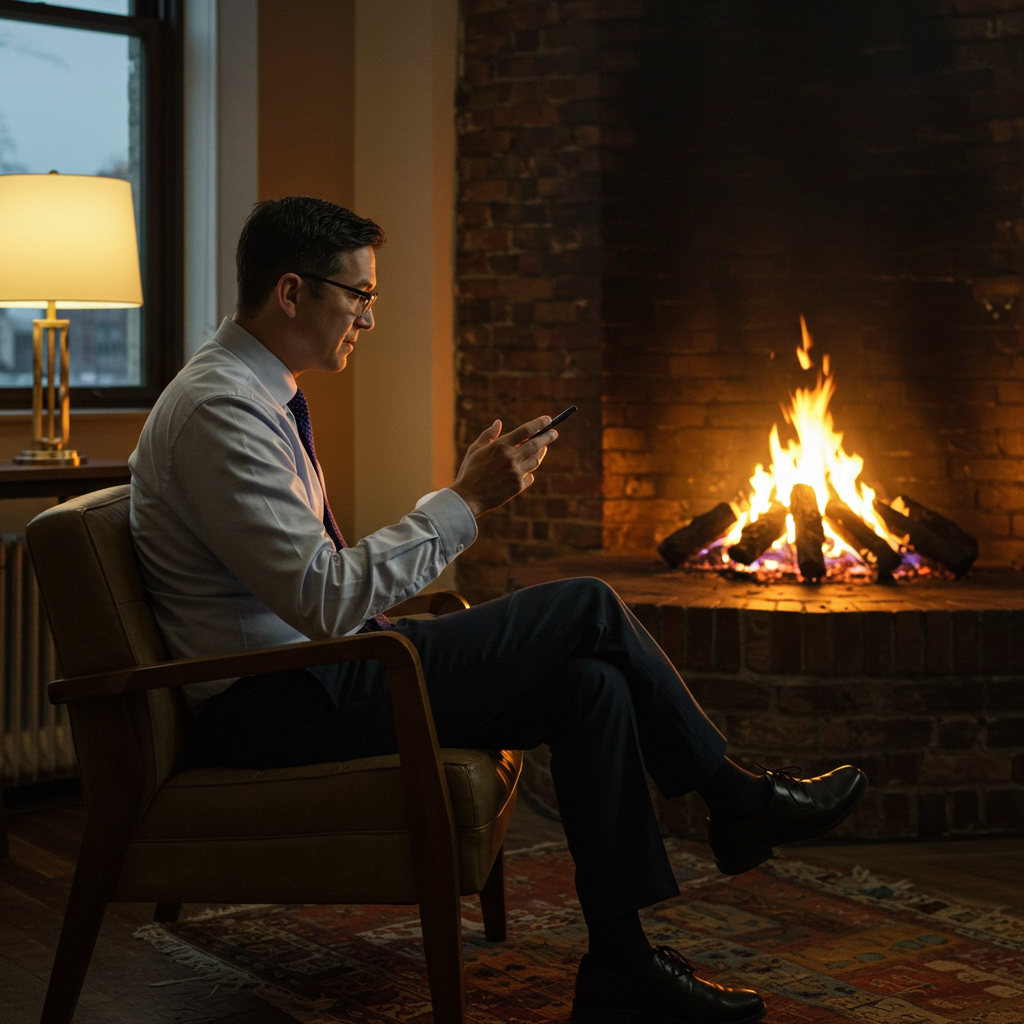
Vision, values, and proposal
Focus on results and measurement
Our vision is to eradicate inauthentic corporate communication. We believe every leader has a powerful story to tell, and our mission is to provide the framework and tools for that story to resonate with clarity and honesty. Our values center on rigorous preparation, radical collaboration, and obsessive measurement. We apply the Pareto principle (80/20): we are convinced that 80% of the success of a natural fireside chat depends on two factors: the speaker’s thorough preparation (not for memorization, but for internalization) and genuine chemistry with the moderator. The remaining 20% corresponds to technical excellence (audio, video, set design), which must be flawless to become invisible and not distract from the human element. Our technical standards are based on broadcast industry best practices, guaranteeing intelligible audio (levels of -12 dB to -6 dB, signal-to-noise ratio > 60 dB) and lighting that fosters visual connection (three-point lighting with soft fill light).
- Core Value Proposition: We transform executives from presenters to conversationalists, achieving an average increase of 40% in audience engagement compared to standard presentation formats.
- Quality Criterion #1 (Authenticity): We measure perceived authenticity through post-event surveys, with a target score of ≥ 8.5/10.
- Quality Criterion #2 (Message Clarity): We verify the retention of the 3 key messages with questionnaires, aiming for a correct recall rate > 75 %.
- Decision Matrix (Investment vs. Impact): We prioritize investments in speaker coaching and moderator selection over spending on opulent sets, as the ROI of human connection consistently surpasses that of visual aesthetics alone.
Services, Profiles, and Performance
Portfolio and Professional Profiles
We offer an end-to-end service portfolio designed to ensure success in the **production of natural executive fireside chats**. Our team comprises multidisciplinary profiles: content producers with experience in investigative journalism, communication coaches specializing in leadership, technical directors with a background in live broadcasts, and data analysts to measure impact. Services can be contracted in modules or as a comprehensive package.
-
- Phase 1: Strategy and Content Design (KPI: Strategic Alignment > 95%):
- Defining objectives (internal, external, financial).
- Audience analysis and profile development (personas).
- Creating the narrative arc and the 3-5 key messages.
- Selecting and briefing the moderator.
- Phase 2: Coaching and Speaker Preparation (KPI: Speaker confidence improvement > 50%):
- One-on-one sessions to develop authenticity and storytelling.
- Recorded rehearsals with analysis and constructive feedback.
- Techniques stress management and body language.
- Phase 3: Technical Production and Execution (KPI: Technical downtime = 0 minutes):
- Set design, lighting, and sound.
- Streaming platform management (if virtual or hybrid).
- Coordination of the technical team on the day of the event.
- Phase 1: Strategy and Content Design (KPI: Strategic Alignment > 95%):
Phase 4: Post-Event Analysis and Reporting (KPI: Report delivered within 48 hours):
-
-
- Analysis of engagement and sentiment metrics.
- Collection of qualitative feedback.
- Results report with recommendations for future events.
-
Tables and examples
> 60% of questions focused on implementation, not justification.Technical NPS of virtual assistants.Dual internet connection redundancy. Full technical testing 24 hours in advance. Dedicated technical support via chat.Technical NPS ≥ 50. Zero transmission interruptions. Audio/video quality complaints < 1%.
| Objective | Indicators | Actions | Expected Outcome |
|---|---|---|---|
| Increase employee confidence in the new corporate strategy. | Pre- and post-event pulse survey (scale 1-10). Rate of strategy questions in Q&A. | Coaching the CEO to explain the “why” with personal stories. Internal moderator (respected leader) to build trust. | Increase the trust score from 6.2 to > 8.0. |
| Improve the perception of approachability and accessibility of leadership. | Sentiment analysis of comments in live chat. Mentions in internal channels (Slack/Teams). | Informal stage setup (armchairs instead of a podium). Unfiltered “Ask me anything” segment. | >85% positive/neutral sentiment. 30% increase in positive mentions of the management team. |
| Ensure flawless technical execution for a hybrid event. | Streaming error rate (< 0.1%). Audio quality (MOS > 4.0). |
Representation, Campaigns, and/or Production
Professional Development and Management
Producing a fireside chat is a complex project management exercise that requires meticulous coordination of multiple vendors, technologies, and talent. Our approach is based on proactive planning and risk management. Logistics encompass everything from venue selection (considering acoustics, capacity, and accessibility) to obtaining the necessary permits if the event is in a public space. We create a reverse execution schedule, starting from the event date, with clear milestones and assigned responsibilities for each task. The coordination of suppliers (catering, audiovisual equipment, furniture, streaming platforms) is centralized through a single point of contact to ensure consistency and avoid communication breakdowns.
- Venue Selection Checklist:
- Acoustics: Low background noise level (< 45 dB)? No excessive reverberation?
- Lighting: Control over natural and artificial light? Sufficient height for the lighting grid?
- Connectivity: Dedicated fiber optic internet connection with redundancy? Sufficient bandwidth for 1080p streaming (minimum 10 Mbps upload)?
- Logistics: Access for loading/unloading equipment?
- Preparation rooms (“green rooms”)?
Contingency Plan (Examples):
- Main microphone failure: Backup lavalier microphones for the speaker and moderator, already equalized and ready at the soundboard.
- Main internet connection failure: Bonded 4G/5G connection as backup, with automatic switchover in less than 5 seconds.
- Speaker freezes due to nerves: The moderator has prepared 3 “lifesaver” questions and a personal anecdote to give the speaker a break and get the conversation back on track.
- Medical emergency: Security and first aid personnel with a clear evacuation protocol communicated at the beginning.
- Critical Documentation:Detailed technical rider for the AV provider.
Technical script (minute-by-minute) for the entire production team.
Conversation roadmap for the moderator (not a script of questions).
Image consent form for all participants.
Content and/or Media That Convert
Messages, Formats, and Conversions
Content is at the heart of a successful fireside chat. The goal isn’t simply to ask questions, but to build a coherent narrative that takes the audience on an emotional and intellectual journey. To achieve this, we use powerful opening hooks, such as a surprising personal anecdote or a thought-provoking question to break the ice. Calls to action (CTAs) are integrated organically into the conversation, rather than feeling like an afterthought. For example, if the goal is to boost adoption of a new internal tool, the CTA could be: “After hearing how this transformed Maria’s day-to-day work, I invite you to try the demo you’ll find on the intranet.” We conduct A/B tests at virtual events, for example, varying the Q&A format (questions voted on by the audience vs. questions selected by the moderator) to see which generates more engagement. The key to a session that feels natural is to prepare a “conversation roadmap” rather than a rigid script. This document contains themes, key anecdotes, and logical transitions, giving the moderator the flexibility to explore interesting tangents without losing the main thread. The goal is to create an environment where the production of natural executive fireside chats feels like a real conversation, not a press interview.
Content Production Workflow:
(Week -4) Discovery Workshop (Responsible: Content Producer): Meeting with the executive and the communications team to define objectives, audience, and key messages. Deliverable: Strategic Briefing Document.
(Week -3) Narrative Arc Research and Development (Responsible: Content Producer): Research on the speaker, the topic, and the audience. Design of the conversation structure (beginning, middle, climax, end). Deliverable: Narrative Arc Proposal.
- (Week -2) Preparation Session with the Speaker (Responsible: Communication Coach): We work on the narrative arc, identifying personal stories and analogies that reinforce the key messages. Answers are not memorized. Deliverable: Speaker Story Map.
- (Week -2) Briefing with the Moderator (Responsible: Content Producer): All information is shared and the strategy is aligned. “No-go zones” and the objectives of the conversation are defined. Deliverable: Conversation Roadmap.
- (Week -1) Joint Rehearsal (Responsible: Technical Director and Producer): A rehearsal of the first and last segments is conducted on stage or in a virtual environment to test chemistry, timing, and technical aspects. Deliverable: Feedback and final adjustments.
- (Day of the Event) Final Briefing (Responsible: Producer): 15-minute review with speaker and moderator just before starting to align energies and review the first point of the conversation.

Training and employability
Demand-driven catalog
To scale an organization’s ability to produce high-quality fireside chats, we offer targeted training programs for the key roles involved.
These modules are designed to be practical, simulation-based, and focused on measurable results.
- Module 1: Internal Moderator Training (Duration: 2 days)
- The art of research and preparation.
- Active listening techniques and how to ask relevant follow-up questions.
- Managing the time and energy of the conversation.
- How to handle difficult speakers or unexpected situations.
- Recorded simulations with personalized feedback.
- Module 2: Communication Coaching for Executives (Duration: 4 sessions of 2 hours each)
- Discovering and refining your authentic communication style.
- Storytelling for leaders: how to connect data with emotions.
- Nonverbal communication: projection, posture, and eye contact.
- Techniques for answering difficult questions with transparency and confidence.
- Module 3: Fundamentals of Technical Production for Event Teams (Duration: 1 day)
- Basic principles of audio, lighting, and video for creating a professional look.
- How to write an effective technical rider.
- Managing streaming platforms and interaction tools (Q&A, surveys).
- Pre-production checklists and troubleshooting common problems.
Methodology
Our training methodology is based on active learning (“learning by doing”). Assessments are conducted using rubrics that measure specific competencies before and after the course, such as “Ability to formulate open-ended questions” or “Effectiveness in the use of personal anecdotes.” All training programs include intensive practice and simulations of real-world scenarios. For organizations, we offer the creation of a pool of certified internal moderators, reducing reliance on external talent and long-term costs. Expected results include an average improvement of 35% in speaker feedback scores and a 25% increase in the Net Promoter Score (NPS) for events moderated by trained internal staff.
Operational Processes and Quality Standards
From Request to Execution
A standardized operational process is the backbone of consistency and quality. Our pipeline is designed to be transparent, collaborative, and efficient, ensuring that all stakeholders are aligned at every stage.
-
- Phase 1: Diagnosis and Proposal (Timeframe: 5 business days)
- Input: Initial client request.
- Process: Discovery workshop to understand objectives (OKRs), audience, context, and constraints.
- Deliverable: Detailed proposal with scope, itemized budget (estimated cost per phase: Strategy 15%, Coaching 25%, Production 50%, Analysis 10%), timeline, and success KPIs.
- Acceptance Criteria: Signing of the proposal and service agreement.
- Phase 2: Pre-production (Timeframe: 4-6 weeks before the event)
- Input: Approved proposal.
- Process: Project kick-off, narrative arc creation, moderator selection, speaker coaching, technical design, vendor booking.
- Deliverable: Technical and Creative Script Document, final Technical Rider, Production Schedule.
- Acceptance Criteria: Final client approval of the creative and technical approach.
- Phase 3: Execution and Broadcast (Deadline: Day of the event)
- Input: Final production plan.
- Process: Setup, final technical tests, on-site rehearsals, pre-show briefing, live execution, management of the Audience interaction.
- Deliverable: Event executed as planned.
- Acceptance Criteria: Broadcast without technical interruptions and adherence to the technical script.
- Phase 4: Closure and Analysis (Timeframe: 3-5 business days post-event)
-
- Input: Event recording and platform data.
- Process: Data collection and analysis (visual analytics, surveys, sentiment analysis), editing of the recording for VOD, internal feedback meeting.
- Deliverable: Post-Event Performance Report with KPI analysis and recommendations.
- Acceptance Criteria: Delivery of the report and video materials to client.
… Delivery of the edited recording in <72 hours.
-
- Phase 1: Diagnosis and Proposal (Timeframe: 5 business days)
Audience participation rate.Risk: Catastrophic technical failure. Mitigation: Full redundancy in critical equipment (microphones, cameras, encoders, internet connection). Complete dress rehearsal.Performance ReportData accuracy. Relevance of recommendations. Compliance with delivery deadlines.Risk: Insufficient data for robust analysis. Mitigation: Integrate survey and analytics tools into the event platform from the initial design.
| Phase | Key Deliverables | Control Indicators | Risks and Mitigation |
|---|---|---|---|
| Diagnosis | Strategic Proposal | Clarity of objectives (scale 1-5). Budget aligned with expectations. | Risk: Misalignment of objectives. Mitigation: Use the OKR framework in the discovery workshop to quantify goals. |
| Pre-production | Technical and Creative Script | Approval from all stakeholders. Tasks on the schedule completed on time (>95%). | Risk: Non-collaborative or time-strapped speaker. Mitigation: Involve the speaker’s executive assistant from the beginning, schedule brief and highly focused coaching sessions. |
| Execution | Live Event | Audio/video quality (real-time monitoring). |
Application Cases and Scenarios
Case 1: Culture Launch for a Post-Series B Tech Startup
Challenge: A rapidly growing startup (from 50 to 250 employees in 12 months) needed its CEO, a highly technical and somewhat uncommunicative founder, to present the company’s new values in a way that would inspire and connect with a diverse and mostly remote workforce. The goal was to avoid a corporate monologue and foster genuine dialogue.
Solution: A virtual fireside chat was designed and moderated by a highly respected veteran employee. The process included four intensive coaching sessions with the CEO, focused on translating abstract values into personal stories from the company’s early days. A set was created in the office that resembled the original “garage.” The production included interactive elements such as real-time word clouds and polls for employees to vote on which value they wanted to discuss next.
Results and KPIs:
- Participation Rate: 85% of employees connected live (target: 70%).
- Event NPS: +65 (excellent).
- Message Retention: In a survey one week later, 80% of employees were able to correctly name 3 of the 5 new values and associate them with one of the CEO’s stories.
- Cost: €12,500, including coaching and virtual production.
- ROI: Qualitative feedback on Slack channels showed a 40% reduction in cynical or negative comments about corporate culture in the following month to the event.
Case 2: Restructuring Communication in an IBEX 35 Company
Challenge: A large energy company needed to communicate a significant restructuring involving role changes for hundreds of employees. The objective was to convey the strategic vision behind the changes, address concerns directly, and maintain morale, avoiding the perception of a cold and distant announcement.
Solution: A hybrid event was organized with the CEO and the Human Resources Director. The format was a fireside chat followed by a completely open Q&A, using a platform that allowed anonymous voting on questions so that the most difficult and popular ones rose to the top. Preparation focused on empathy and transparency. The CEO was coached to acknowledge the difficulty of the news and share her own vulnerability in the decision-making process. The moderator was an external economics journalist known for his incisive yet fair style.
Results and KPIs:
- Handling Difficult Questions: The 10 most voted questions were answered, including topics on job security and compensation.
- Sentiment Analysis: Although initially negative (as expected), sentiment in the chat improved by 30% from the beginning to the end of the session, shifting from “fear” to “understanding” and “cautious optimism”.
- Budget Deviation: <2% on a budget of €45,000.
- Qualitative Feedback: Post-event surveys showed that 75% of attendees valued the “transparency” and “courage” of the session, even if they did not agree with the decisión.
Caso 3: Evento de Captación de Fondos para una ONG Medioambiental
Desafío: Una ONG necesitaba un formato más atractivo que su gala anual tradicional para conectar con grandes donantes. El objetivo era presentar el impacto de su trabajo de una manera emocionalmente resonante y demostrar la urgencia de su misión, impulsando donaciones significativas durante el evento.
Solución: Se reemplazó el discurso principal por un fireside chat entre la directora de la ONG y un científico de campo que acababa de regresar de una expedición en el Amazonas. La producción se realizó en un entorno íntimo, utilizando una iluminación dramática y un diseño de sonido que incorporaba grabaciones de la selva. Durante la conversación, se proyectaron imágenes y vídeos cortos (B-roll) en una gran pantalla detrás de ellos, mostrando el trabajo en acción. El moderador (un conocido presentador de televisión pro-bono) guió la conversación para resaltar no solo los desafíos, sino también las historias de éxito y esperanza.
Resultados y KPIs:
- Recaudación de fondos: Se recaudaron 1,2 millones de euros durante el evento, un 20 % por encima del objetivo y un 35 % más que el año anterior.
- ADR (Average Donation Rate): La donación promedio por asistente aumentó en un 15 %.
- Engagement post-evento: El número de asistentes que solicitaron información para unirse a un viaje de donantes se triplicó.
- Coste de producción: 60.000 €.
- ROI: 20:1, medido en fondos recaudados frente al coste del evento.
Guías paso a paso y plantillas
Guía 1: Preparación del Ponente Ejecutivo para la Autenticidad
- Definir el “Único Mensaje Verdadero” (Semana -4): Olvídate de los 5 puntos clave. Si la audiencia solo pudiera recordar UNA cosa, ¿cuál sería? Esta será la estrella polar de toda tu preparación. Debe ser algo en lo que creas profundamente.
- Mapeo de Historias, no de Datos (Semana -3): Para cada tema de la hoja de ruta de la conversación, identifica una historia personal o una anécdota que lo ilustre. Las personas recuerdan historias, no estadísticas. Crea un “banco de historias” del que puedas tirar.
- Internalizar, no Memorizar (Semana -2): Lee la hoja de ruta de la conversación varias veces, pero no intentes memorizar respuestas. El objetivo es que los temas y las historias fluyan de forma natural. Practica contar tus historias clave a un colega o familiar en un tono conversacional.
- El Ensayo de “Peor Escenario” (Semana -1): Realiza un ensayo con tu coach o moderador donde te hagan las preguntas más difíciles o incómodas que puedas imaginar. Esto te prepara para cualquier cosa y reduce la ansiedad.
- Conectar con el Moderador (Semana -1): Ten una llamada informal de 15-20 minutos con el moderador sin hablar del contenido. Habla de aficiones, familia, lo que sea. Construir una conexión humana real antes de subir al escenario es crucial para la química.
- El Día D: Rutina de Preparación (Día del Evento):
- Evita reuniones estresantes 3 horas antes.
- Realiza ejercicios de respiración o meditación 15 minutos antes.
- Repasa tu “Único Mensaje Verdadero” una vez.
- Confía en tu preparación y concéntrate en tener una conversación real con el moderador.
Guía 2: Checklist Técnico Esencial para un Fireside Chat Híbrido
- Audio (Prioridad #1):
-
- [ ] Dos micrófonos de solapa de alta calidad (p. ej., Sennheiser, Shure) por persona (principal y backup).
- [ ] Mesa de mezclas de audio con capacidad para ecualizar las voces por separado.
–
- [ ] Prueba de sonido completa en la sala vacía y con algo de público para ajustar niveles.
- [ ] El audio para el streaming debe ser una mezcla post-fader para garantizar la misma calidad que en la sala.
-
- Vídeo e Iluminación:
- [ ] Mínimo 3 cámaras: un plano general, un plano medio de cada participante.
- [ ] Iluminación de tres puntos (principal, relleno, contraluz) para cada persona para evitar sombras y crear profundidad.
- [ ] Temperatura de color de todas las luces consistente (p. ej., 3200K para un look cálido).
- [ ] Realizador en vivo para cambiar de plano de forma dinámica y mantener el interés visual.
- Streaming y Plataforma:
- [ ] Conexión a internet principal por fibra (mínimo 20 Mbps de subida) y backup 4G/5G.
- [ ] Codificador de hardware (más fiable que por software) para la transmisión.
- [ ] Plataforma de eventos que permita Q&A, sondeos y chat en vivo.
- [ ] Página de visionado de marca con agenda e información de los ponentes.
- [ ] Grabación local y en la nube simultánea como doble seguridad.
Guía 3: Plantilla de Flujo de Conversación (No Guion)
Este documento es para el moderador. El ponente solo debe conocer los temas generales.
- Segmento 1: La Conexión Humana (5-7 minutos)
- Objetivo: Romper el hielo, mostrar al ejecutivo como persona.
- Pregunta de apertura: Algo inesperado y personal, no relacionado con el negocio. (Ej: “¿Cuál fue el primer concierto al que fuiste?”).
- Transición: Enlazar la anécdota con un rasgo de carácter relevante para su liderazgo. (Ej: “Esa perseverancia para ver a tu banda favorita parece un rasgo que…”).
- Segmento 2: El Contexto y el Desafío (10-15 minutos)
- Objetivo: Establecer el “porqué” de la conversación. Presentar el problema o la oportunidad.
- Temas a explorar: El estado del mercado, el desafío interno, el momento “eureka” que llevó a la estrategia actual.
- Historias clave del ponente a evocar: La historia del “origen” del problema.
- Segmento 3: La Visión y la Estrategia (15-20 minutos)
- Objetivo: Articular el plan de futuro de forma clara y convincente. Este es el núcleo del mensaje.
- Temas a explorar: Los 2-3 pilares de la estrategia, cómo se medirá el éxito, el papel de los empleados/clientes en ella.
- CTA integrado: Momento para la llamada a la acción principal.
- Segmento 4: Interacción con la Audiencia (15 minutos)
- Objetivo: Demostrar escucha y transparencia.
- Proceso: Empezar con una pregunta pre-seleccionada para calentar motores, luego pasar a las preguntas más votadas de la audiencia.
- Segmento 5: Cierre y Mirada al Futuro (3-5 minutos)
- Objetivo: Terminar con una nota de inspiración y claridad.
- Pregunta final: Una pregunta amplia y reflexiva. (Ej: “Dentro de tres años, cuando mires atrás a este momento, ¿de qué te sentirás más orgulloso?”).
- Resumen del moderador: Recapitular el “Único Mensaje Verdadero” en una frase.
Recursos internos y externos (sin enlaces)
Recursos internos
- Plantilla de Briefing Estratégico para Fireside Chats.
- Checklist Completo de Producción Técnica (150 puntos).
- Plantilla de Hoja de Ruta de Conversación para Moderadores.
- Modelo de Encuesta Post-Evento para medir NPS y Retención de Mensajes.
- Catálogo de Proveedores de AV y Plataformas de Streaming recomendados.
Recursos externos de referencia
- Libro “Talk Like TED” de Carmine Gallo – Principios de storytelling aplicables.
- Libro “Crucial Conversations” – Herramientas para hablar cuando hay mucho en juego.
- Estándares de la Society of Motion Picture and Television Engineers (SMPTE) para calidad de vídeo.
- Recomendaciones de la Audio Engineering Society (AES) para inteligibilidad de la voz.
- Guías de buenas prácticas de iluminación de ARRI.
Preguntas frecuentes
¿Cuál es el coste aproximado de producir un fireside chat profesional?
El rango es amplio. Un fireside chat interno y virtual puede costar entre 5.000 € y 15.000 €, incluyendo coaching y una plataforma robusta. Un evento híbrido de alto perfil para una audiencia externa puede oscilar entre 30.000 € y más de 100.000 €, dependiendo de la sede, el equipo técnico, el talento del moderador y la complejidad de la producción.
¿Cómo se maneja una pregunta hostil o inesperada de la audiencia?
La clave está en la preparación. Se utiliza una técnica de 3 pasos: 1) Validar la emoción de la pregunta (“Entiendo tu preocupación por…”). 2) Redirigir al mensaje clave (“Eso se conecta con nuestro compromiso con…”). 3) Responder de forma concisa y honesta sin ser defensivo. El moderador también está entrenado para intervenir si es necesario y mantener un tono constructivo.
¿Es mejor un moderador interno o externo?
Depende del objetivo. Un moderador interno (como un empleado respetado) puede generar un ambiente de confianza y familiaridad, ideal para eventos de cultura interna. Un moderador externo (un periodista o experto de la industria) aporta credibilidad, objetividad y a menudo una mayor habilidad para hacer preguntas incisivas, lo que es ideal para audiencias de inversores o clientes.
¿Cómo se puede medir el ROI de un evento que parece tan “blando”?
El ROI se mide vinculando los objetivos del chat a métricas de negocio. Si el objetivo era mejorar la moral, se mide con encuestas de pulso pre y post-evento y se correlaciona con tasas de rotación. Si era para inversores, se mide el sentimiento en los informes de analistas posteriores. Para un lanzamiento de producto, se mide el tráfico a la página de producto y las conversiones post-evento. La clave es definir los KPIs medibles desde el principio.
¿Cuánto tiempo de preparación necesita un ejecutivo?
Recomendamos un mínimo de 4 a 6 horas de trabajo dedicado durante las 3-4 semanas previas al evento. Esto se divide en varias sesiones: un taller de mensajes, dos sesiones de coaching y un ensayo final. Es una inversión de tiempo significativa, pero el retorno en términos de impacto y autenticidad es inmenso.
Conclusión y llamada a la acción
En definitiva, la **producción de fireside chats ejecutivos naturales** no es un accidente afortunado, sino el resultado de un proceso disciplinado que fusiona el arte de la comunicación humana con la ciencia de la producción de eventos. Hemos visto cómo una metodología rigurosa, centrada en la preparación del ponente, la creación de un arco narrativo y una ejecución técnica impecable, puede transformar un formato potencialmente incómodo en una poderosa herramienta de liderazgo. Al medir el éxito con KPIs claros como el NPS (+65 en nuestro caso de estudio), la tasa de participación (>85 %) y el impacto medible en objetivos de negocio (ROI de 20:1), demostramos que la autenticidad no solo es deseable, sino también rentable. El camino hacia conversaciones genuinas que inspiren, motiven y conecten requiere inversión y esfuerzo, pero los resultados —confianza, alineación y compromiso— son invaluables. No dejes tu próxima comunicación de liderazgo al azar. Empieza hoy a aplicar estos principios para construir puentes, no muros, con tu audiencia.
Glosario
- Fireside Chat
- Formato de evento en el que un moderador entrevista a uno o más ponentes en un entorno relajado e informal, similar a una conversación junto a una chimenea, para fomentar un diálogo más auténtico.
- NPS (Net Promoter Score)
- Métrica que mide la lealtad y satisfacción de la audiencia de un evento, basada en la respuesta a la pregunta “¿Qué probabilidad hay de que recomiendes este evento a un colega?”.
- B-Roll
- Material de vídeo suplementario o alternativo que se intercala con la toma principal. Se utiliza para añadir contexto visual y dinamismo a una conversación.
- Rider Técnico
- Documento que detalla todos los requisitos técnicos (audio, vídeo, iluminación, escenario, etc.) necesarios para una producción, enviado a los proveedores y al personal del lugar.
- Tasa de Participación (Engagement Rate)
- Porcentaje de la audiencia que participa activamente en un evento a través de acciones como hacer preguntas, responder a sondeos, comentar en el chat, etc.
- Arco Narrativo
- La estructura de una historia o conversación, que típicamente incluye una introducción, un desarrollo con tensión creciente, un clímax y una resolución. Se utiliza para hacer el contenido más atractivo y memorable.
Internal links
- Click here👉 https://uk.esinev.education/masters/
- Click here👉 https://uk.esinev.education/diplomates/
External links
- Princeton University: https://www.princeton.edu
- Massachusetts Institute of Technology (MIT): https://www.mit.edu
- Harvard University: https://www.harvard.edu
- Stanford University: https://www.stanford.edu
- University of Pennsylvania: https://www.upenn.edu