
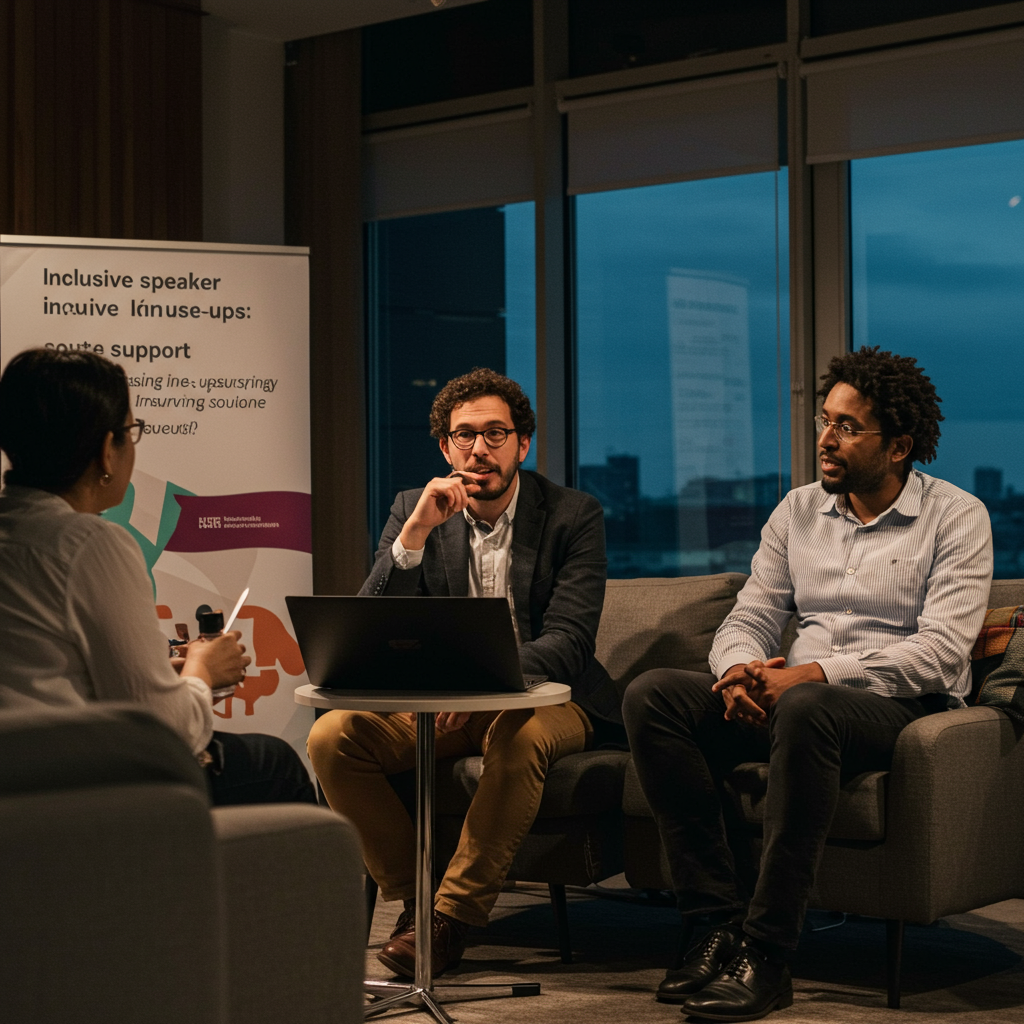
The Definitive Guide to Inclusive Speaker Line-up Sourcing
This article provides a comprehensive methodology for planning, sourcing, and supporting truly inclusive speaker panels. We address how inclusive speaker line-up sourcing goes beyond simply meeting quotas, transforming into a strategic advantage that drives innovation, expands market reach, and enhances brand reputation. Through auditable processes, step-by-step guides, and case studies, we demonstrate how to achieve at least a 30% increase in the representation of underrepresented groups, improve the event’s Net Promoter Score (NPS) by >10 points, and keep budget deviation below 5%. This guide is aimed at event organizers, marketing directors, and diversity and inclusion leaders who seek to create memorable and meaningful experiences.
Introduction
In the competitive world of corporate events, conferences, and summits, content quality is paramount. However, for decades, speaker panels have reflected a homogenous worldview, often excluding vital voices, experiences, and perspectives. This lack of diversity is not just a matter of aesthetics; it’s a missed business opportunity. An event that fails to reflect its audience or the global market loses relevance, credibility, and the capacity for innovation. This is where a deliberate strategy of inclusive speaker line-up sourcing becomes a key differentiator. This approach is not about simply “ticking boxes” for diversity, but rather a proactive and structured process for identifying, contacting, preparing, and supporting experts from all backgrounds, ensuring that the event truly reflects excellence and plurality.
Our methodology is based on a continuous improvement cycle: Define, Measure, Analyze, Improve, and Control (DMAIC). We begin by defining what “inclusivity” means for your specific event, establishing clear metrics such as the percentage of representation by demographic (gender, ethnicity, geography, disability, etc.), audience satisfaction score (NPS), and impact on media coverage. We will measure the performance of each sourcing phase, from the initial search to post-event feedback, using key performance indicators (KPIs) such as the response rate of contacted speakers, the cost per speaker acquisition, and the average session rating. This data-driven approach allows us not only to create a diverse panel for an event, but also to build a sustainable and scalable system for all future events.
 width=”1024″ height=”683″>
Vision, Values, and Proposal
Focus on Results and Measurement
Our vision is to transform events from mere information transmitters into catalysts for change, connection, and innovation through diversity of thought. We believe that an inclusive panel is not an add-on, but the core of a successful event. Our values center on equity, excellence, and measurable impact. We apply the Pareto principle (80/20), focusing our efforts on sourcing actions that generate the greatest impact on panel diversity and quality. This means going beyond traditional networks and using semantic search tools, collaborating with specialized organizations, and building long-term relationships with underrepresented communities. Our technical standard aligns with the ISO 20121 guidelines on event sustainability management, which includes social responsibility and inclusion as fundamental pillars.
Main Value Proposition: Increase the ROI of events through greater relevance and audience engagement, achieved through speaker panels that reflect the diversity of the global market.
Quality Criterion #1: Representativeness must be intersectional. It is not enough to have a speaker from one group; we seek individuals whose multiple identities bring unique richness.
Quality Criterion #2: Fair and equitable compensation. We audit and recommend fees that eliminate historical pay gaps based on gender or ethnicity in the conference circuit.
- Speaker Selection Decision Matrix:
- Experience and Knowledge (40%): Is the speaker a recognized expert in their field?
- Communication Skills (30%): Can they convey complex ideas clearly and engagingly?
- Contribution to Diversity (20%): Does their unique perspective enrich the discussion and represent a broader audience?
- Professionalism and Reliability (10%): Do they have good references and are they easy to work with?
Services, Profiles and Performance
Portfolio and Professional Profiles
We offer a suite of modular services designed to guide organizations through every stage of inclusive speaker line-up sourcing. Our services range from strategic consulting to full implementation, adapting to each client’s needs and resources. The profiles we manage are not limited to “diversity speakers”; they are top-tier experts in technology, finance, science, art, and more, who also come from diverse backgrounds. This ensures that inclusion doesn’t sacrifice quality, but rather enhances it.
- Audit and Strategy Service: We analyze your last 3-5 events, evaluate panel composition, and develop a tailored diversity strategy with quantifiable objectives.
- Sourcing and Selection Service: We use our proprietary database, networks, and search technology to identify and shortlist candidates who meet your experience and diversity criteria.
- Speaker Support and Coaching Service: We offer preparation sessions, presentation rehearsals, and logistical support to ensure that all speakers, especially those with less experience on large stages, can shine.
- Comprehensive Inclusive Event Management Service: We handle the entire process, from defining the theme to moderating the event and conducting post-event analysis.
- School Management of Inclusive Events: We take care of the entire process, from defining the theme to moderating the event and conducting post-event analysis.
Operational Process
-
- Phase 1: Discovery and Definition (1 week): Workshop with the client to define the event’s diversity objectives, key themes, and audience profile. KPI: Approval of the “Event Diversity Charter” with numerical targets (e.g., 50% women, 20% BIPOC, 10% LGBTQ+).
- Phase 2: Sourcing and Mapping (2-3 weeks): Active sourcing process using multiple channels. KPI: Generation of a “long list” with at least 3-5 diverse candidates for each speaker position.
- Phase 3: Contact and Selection (2 weeks): Initial contact, interviews, and negotiation. KPI: Speaker acceptance rate > 40%.
Phase 4: Preparation and Onboarding (4 weeks before the event): Coaching sessions, coordination of materials and logistics. KPI: Speaker satisfaction rating with the onboarding process > 8/10.
Phase 5: Execution and On-Site Support (Day of the event): On-site management, technical testing, inclusive waiting area. KPI: Zero technical or logistical issues related to speakers.
Phase 6: Feedback and Analysis (1 week post-event): Gathering feedback from the audience and speakers, KPI analysis. KPI: Delivery of an impact report with NPS and ROI analysis.
Tables and examples
| Objective | Indicators (KPIs) | Actions | Expected result |
|---|---|---|---|
| Increase gender representation on a technology panel | – % of female/non-binary speakers – Audience rating on “content relevance” |
– Contact associations (e.g., Women in Tech) – Audit lists of “experts” in the sector – Offer coaching to speakers Emerging Achieve a panel with a minimum of 40% women and a 1.5-point increase in relevance rating (scale 1-5). Improve geographic diversity at a global summit. – Number of countries represented – Percentage of attendance from non-traditional regions – Collaborate with innovation hubs in Africa, Latin America, and Southeast Asia – Offer flexible session times for different time zones – Subtitling in multiple languages Increase the representation of speakers from outside North America/Europe from 10% to 35%. Increase attendance from these regions by 25%. |
|
| Incorporate perspectives of people with disabilities | – Percentage of speakers who identify as having a disability – NPS of attendees with disabilities – Accessibility audit of the event (physical and digital) |
– Consult with disability advocacy organizations – Ensure the platform and venue are 100% accessible – Hire sign language interpreters |
Achieve 5% representation and an NPS score > 50 in the attendees with disabilities segment. |

Representation, Campaigns, and/or Production
Professional Development and Management
“Support” in “sourcing and support” is as crucial as the sourcing itself. A true commitment to inclusion means creating an environment where all speakers feel valued, prepared, and able to deliver their best. This requires impeccable logistics and proactive management. Our process covers everything from contract signing to post-event follow-up, ensuring an exceptional speaker experience. We coordinate all aspects: travel, accommodation, technical requirements, and manage all necessary suppliers (audiovisual, translators, etc.) with a focus on inclusion (e.g., catering that considers diverse dietary and cultural needs, rest and meditation rooms).
Documentation and Contracting Checklist:
Clear contract specifying fees, covered expenses, intellectual property rights for the content, and event code of conduct.
Logistical and technical requirements form (travel needs, AV, accessibility).
Recording release agreement (if applicable).
Contingency Plan Checklist:
Pre-identified backup speaker for critical sessions.
Plan B for technical failures (backup internet connection, duplicate AV equipment).
- Communication protocol in case of cancellation or emergency of the speaker.
- Moderator trained to manage unforeseen situations or hostile questions from the audience.
- Welcome and On-Site/Virtual Support Checklist:
- Personal contact assigned to each speaker to answer questions.
- A well-equipped “green room” (physical or virtual) that offers a quiet space to prepare.
- Mandatory and complete technical test at least 24 hours before the session.
- Clear information about the session structure, the audience profile, and the other panelists.

Content and/or Media That Convert
Messages, Formats, and Conversions: The Value of Inclusive Speaker Sourcing
Diversity in a speaker panel translates directly into richer, more relevant content with greater conversion power. When audiences see themselves reflected on stage, their engagement increases. When ideas are presented from unexpected angles, innovation flourishes. Our content strategy focuses on leveraging this diversity. We work with speakers to refine their messages (hooks), ensuring they resonate with the event’s objectives and the audience. We design interactive session formats (workshops, debates, AMAs) that encourage participation. We implement clear calls to action (CTAs) at the end of each session to convert interest into action, whether it’s downloading a report, registering for a demo, or joining a community. We measure success with metrics such as CTA click-through rate, session viewing time, and social media mentions, often conducting A/B tests on session titles to maximize interest.
- Content Production Workflow:
- Task: Ideation session with the client and the content team.Responsible: Event Director.
- Task: Defining the main topics and subtopics of the event.Responsible: Content Curator.
- Task: Initiate the inclusive speaker line-up sourcing process for each topic.Responsible: Sourcing Specialist.
- Task: Conduct content briefing sessions with each confirmed speaker to align their presentation with the event objectives.Responsible: Content Curator.
- Task: Review presentation drafts (optional, with speaker consent).Responsible: Speaker Coach.
- Task: Create marketing materials (session summaries, speaker biographies, social media posts) to promote the sessions.Responsible: Content Marketing Specialist.
- Task: Final technical and content rehearsal.Responsible: Technical Producer and Speaker Coach.

Training and employability
Demand-driven catalog
To create a sustainable and inclusive events ecosystem, it is essential to invest in the training of both organizers and emerging talent.
We offer a catalog of training courses designed to close skills and knowledge gaps in the market.
- Module 1: Fundamentals of Inclusive Sourcing for Organizers. Content: unconscious biases in selection, tools and techniques for searching outside of traditional networks, how to write inclusive speaker invitations.
- Module 2: Inclusive Panel Moderation. Content: how to ensure equitable distribution of speaking time, manage interruptions and mansplaining, and handle difficult or inappropriate questions from the audience.
- Module 3: Public Speaking Workshop for Emerging Speakers. Content: structuring an impactful presentation, storytelling techniques, managing body language and nerves, designing effective slides.
- Module 4: Personal Branding for Experts. Content: how to optimize profiles on professional networks, create a speaker kit, and build relationships with event organizers.
Methodology
Our training methodology is practical and results-oriented. We use a rubric-based assessment system that measures the acquisition of specific skills. Sessions include recorded practice with personalized feedback from experienced coaches. For emerging speakers, we maintain an active talent pool, connecting our workshop graduates with paid speaking opportunities. The expected outcome is a measurable increase in the participants’ confidence and competence, with the goal of 80% of the public speaking workshop graduates securing at least one presentation within six months of completing the course.
Operational Processes and Quality Standards
From Request to Execution
A standardized operational process is key to ensuring quality and efficiency in sourcing inclusive speakers. Our pipeline is designed to be transparent, auditable, and focused on the client and the speaker.
-
- Diagnosis (Phase 1): We receive the client’s request. We conduct an initial meeting to understand the event objectives, the audience, the budget, and the diversity goals.
- Deliverable: Event Briefing Document.
- Acceptance Criteria: Signed approval by the client.
- Proposal (Phase 2): We develop a customized sourcing strategy, including a timeline, detailed budget, and proposed KPIs.
- Deliverable: Service Proposal and Contract.
- Acceptance Criteria: Signed contract and initial payment.
- Pre-production (Phase 3): We execute the sourcing strategy, select and confirm speakers, and begin the onboarding and preparation process.
- Deliverable: Final list of confirmed speakers and preparation schedule.
- Acceptance Criteria: All speakers with signed contracts and scheduled rehearsal dates.
- Execution (Phase 4): We provide full support during the event, managing speaker logistics and session production.
- Deliverable: Event executed smoothly.
- Acceptance Criteria: Compliance with the technical support SLA (< 5 minutes response time).
- Closure (Phase 5): We gather feedback, analyze the results against the KPIs, and deliver a final impact report.
- Deliverable: Results and Recommendations Report.
- Acceptance Criteria: Closing meeting with the client to review the report and plan next steps.
- Diagnosis (Phase 1): We receive the client’s request. We conduct an initial meeting to understand the event objectives, the audience, the budget, and the diversity goals.
Quality Control
Quality control is integrated into every phase of the process, with clear roles and responsibilities and defined Service Level Agreements (SLAs).
-
-
-
- Roles: The Account Manager is the client’s main point of contact. The Sourcing Specialist leads the search. The Speaker Coach is responsible for preparation. The Technical Producer manages the execution.Escalation: Any deviation of more than 10% from the schedule or budget is immediately escalated to the Project Manager for resolution.
Acceptance Indicators: Customer satisfaction (CSAT) must be ≥ 4.5/5. Presenter satisfaction must be ≥ 8/10. The final panel must meet or exceed the diversity objectives defined in Phase 1.
- Roles: The Account Manager is the client’s main point of contact. The Sourcing Specialist leads the search. The Speaker Coach is responsible for preparation. The Technical Producer manages the execution.Escalation: Any deviation of more than 10% from the schedule or budget is immediately escalated to the Project Manager for resolution.
-
-
Final Impact ReportROI analysis; positive client feedback.Risk: The data does not demonstrate a clear impact. Mitigation: Establish clear and measurable success metrics from the outset.
| Phase | Key Deliverables | Control Indicators | Risks and Mitigation |
|---|---|---|---|
| Diagnosis | Event Briefing | 100% clarity and agreement on diversity objectives. | Risk: Vague or unrealistic diversity objectives. Mitigation: Use benchmarking data to set achievable and specific goals. |
| Pre-production | List of confirmed speakers | Confirmation rate > 40%; 100% achievement of diversity goals. | Risk: Difficulty finding experts in specific niches of underrepresented groups. Mitigation: Extend the search time and activate specialized networks. |
| Execution | Speaker sessions delivered | Audience NPS per session; 0 critical technical failures. | Risk: A speaker cancels at the last minute. Mitigation: Have a backup speaker on standby for key topics; have an emergency recorded session. |
Case Studies and Application Scenarios
Case 1: Transforming a Fintech Conference
Challenge: “Fintech Forward,” a leading annual conference, was facing criticism on social media for its “manels” (all-male panels). Its 2021 panel was 85% white men, resulting in a 15% drop in female attendance and an overall NPS of only 25. The goal was to reverse this trend within 12 months.
Solution: We implemented a comprehensive inclusive speaker line-up sourcing process.
Solution:
-
- Audit: We analyzed panels from the last 3 years to identify patterns of exclusion.
- Strategy: We set a target of 50% women and 30% representation of ethnic minorities (BIPOC), focusing on technical and leadership roles, not just marketing or HR.
- Sourcing: We collaborate with networks such as “Women in Fintech” and “Black Venture Capital Consortium.” We used advanced Boolean searches on LinkedIn to find female experts who weren’t on the usual conference circuit.Support: We offered a public speaking workshop for 8 first-time speakers, covering all costs and providing one-on-one coaching.
Results:
The 2022 panel achieved 52% women and 35% BIPOC.
Female attendance increased by 40%.
The overall NPS soared to 48 (+23 points).
Positive media coverage increased by 200%, specifically mentioning the event’s diversity.
ROI: The increase in ticket sales and sponsorships generated a 350% ROI on the investment in sourcing and coaching. The implementation period was 6 months.
Case 2: Global Sustainability Summit
Challenge: A summit on the SDGs (Sustainable Development Goals) organized in Geneva was dominated by voices from the “Global North” (Europe and North America), which contradicted the spirit of the SDGs themselves. They needed to incorporate authentic perspectives from the regions most affected by climate change and inequality.
Solution: The approach focused on geographic and socioeconomic diversity.
-
-
- Ecosystem Mapping: We identified community leaders, social entrepreneurs, and scientists in Sub-Saharan Africa, Southeast Asia, and Latin America through local NGOs and universities.
- Barrier Removal: The client covered visa and travel costs and offered fair compensation. For those unable to travel, high-quality live streaming hubs were created in their home cities.Content Co-creation: Pre-event virtual workshops were organized so that speakers from different regions could collaborate on joint panels, creating a truly global dialogue rather than isolated presentations.
Results:
Speakers from 25 different countries, with 40% coming from the Global South (up from 5% the previous year).
The event was streamed in 3 languages (English, Spanish, French), increasing virtual reach by 150%.
Five new transcontinental project partnerships were generated directly from the connections made during the panels.
The Average Daily Rate (ADR) for premium virtual attendance increased by 20% due to the quality and exclusivity of the event. contenido.
-
Caso 3: Evento Interno de Lanzamiento de Producto de una Empresa Tecnológica
Desafío: Una empresa de software global con 50.000 empleados lanzaba un nuevo producto. Los eventos de lanzamiento anteriores habían sido criticados internamente por presentar siempre al mismo grupo de ejecutivos (mayoritariamente hombres, blancos, de la sede de EE. UU.), desmotivando a su fuerza laboral global.
Solución: El objetivo era que el escenario reflejara la diversidad de los equipos que realmente construyeron el producto.
-
-
-
- Sourcing Interno: Trabajamos con los líderes de ingeniería, diseño y producto de la empresa para identificar a los contribuyentes clave del proyecto en sus oficinas de India, Irlanda, Israel y Brasil.
- Coaching Ejecutivo: Muchos de estos expertos técnicos no tenían experiencia como oradores. Se implementó un programa de coaching intensivo de 6 semanas para ayudarles a contar la historia de su contribución de una manera atractiva.
- Formato Innovador: En lugar de una serie de discursos, el lanzamiento se diseñó como un documental en vivo, alternando demos de producto con historias personales de los empleados que lo crearon.
-
-
Resultados:
-
-
- El evento contó con presentadores de 8 nacionalidades diferentes, con un equilibrio de género del 50/50 y una representación de diferentes niveles de antigüedad.
- La encuesta de engagement de los empleados post-evento mostró una puntuación récord de 9,2/10 en “sentirse orgulloso de trabajar en la empresa”.
- El NPS interno del evento fue de 75, el más alto en la historia de la compañía.
- El vídeo del lanzamiento se convirtió en una poderosa herramienta de reclutamiento, contribuyendo a una reducción del 10 % en el tiempo para cubrir vacantes de ingeniería en los siguientes 6 meses.
-
Guías paso a paso y plantillas
Guía 1: Auditoría Rápida de la Diversidad de tu Evento (Checklist)
Utiliza esta guía para evaluar rápidamente la inclusividad de tu próximo panel de ponentes. A cada “Sí” dale 1 punto. Una puntuación por debajo de 7 indica una necesidad urgente de mejorar tu estrategia de sourcing.
- Paso 1: Analiza la Representación Visual. ¿El panel propuesto visualmente parece diverso en términos de género y etnia? (Sí/No)
- Paso 2: Revisa la Diversidad de Roles. ¿Las mujeres y las personas de color están representadas en roles de liderazgo y técnicos, o solo en temas “blandos” como cultura o RRHH? (Sí/No)
- Paso 3: Considera la Diversidad Geográfica. Si es un evento global, ¿están representadas voces de diferentes continentes y no solo de la sede de tu empresa? (Sí/No)
- Paso 4: Piensa en la Diversidad de Pensamiento. ¿Todos los ponentes provienen del mismo tipo de empresa (p. ej., todas son grandes corporaciones) o hay representación de startups, academia, ONGs, etc.? (Sí/No)
- Paso 5: Evalúa la Interseccionalidad. ¿Reconoces y valoras a ponentes que representan múltiples identidades (p. ej., una mujer negra LGTBQ+ en tecnología)? (Sí/No)
- Paso 6: Revisa tu Proceso de Sourcing. ¿Has ido más allá de “preguntar a tus amigos y colegas” para encontrar ponentes? ¿Has consultado bases de datos especializadas o grupos comunitarios? (Sí/No)
- Paso 7: Confirma la Inclusión del Moderador. ¿El moderador del panel también es diverso y está entrenado para gestionar una conversación inclusiva? (Sí/No)
- Paso 8: Verifica la Accesibilidad. ¿Has preguntado a los ponentes si tienen alguna necesidad de accesibilidad (física, sensorial, etc.)? (Sí/No)
- Paso 9: Analiza la Compensación. ¿Estás ofreciendo una compensación equitativa a todos los ponentes de un nivel similar, sin importar su origen? (Sí/No)
- Paso 10: Planifica el Futuro. ¿Tienes un sistema para rastrear la diversidad de tus ponentes a lo largo del tiempo y establecer metas de mejora? (Sí/No)
Guía 2: Plantilla de Email de Contacto Inclusivo
Un primer contacto mal redactado puede disuadir a un ponente potencial. Utiliza esta plantilla como base.
- Asunto: Invitación para compartir tu experiencia en [Tema Específico] en [Nombre del Evento](Evita asuntos genéricos. Demuestra que has investigado a la persona).
- Saludo Personalizado: Estimada/o [Nombre del Ponente],(Usa su nombre correcto y pronombre si lo conoces).
- Hook y Reconocimiento: He seguido con gran interés tu trabajo en [proyecto, artículo o charla específica], especialmente tu análisis sobre [menciona algo concreto]. Tu perspectiva sería increíblemente valiosa para nuestra audiencia en [Nombre del Evento].(Esto demuestra un interés genuino y no un email masivo).
- Contexto del Evento: [Nombre del Evento] es una conferencia que reunirá a [número] de [tipo de profesionales] para discutir [tema principal]. Este año, estamos particularmente enfocados en [menciona el enfoque del evento]. Estamos comprometidos a crear un panel de ponentes diverso y representativo, y es por eso que nos encantaría contar contigo.(Sé transparente sobre tus objetivos de inclusión).
- La Petición Clara: Nos gustaría invitarte a participar en un panel titulado “[Título del Panel]” el [Fecha] a las [Hora], o a dar una charla individual de [Duración] minutos. El tema propuesto es [Tema Sugerido], pero estamos abiertos a tus ideas.
- Información sobre Compensación y Soporte: Ofrecemos a todos nuestros ponentes una compensación de [Cantidad o rango] €, además de cubrir todos los gastos de viaje y alojamiento. También proporcionamos soporte que incluye [menciona beneficios como coaching, apoyo técnico, etc.].(Ser transparente sobre la compensación desde el principio respeta el tiempo del ponente).
- Llamada a la Acción: ¿Tendrías 15 minutos la próxima semana para una breve llamada y discutir esta oportunidad? Puedes reservar un horario directamente en mi calendario aquí: [Enlace al Calendario].
- Cierre: Agradezco de antemano tu tiempo y consideración. Saludos cordiales, [Tu Nombre].
Guía 3: Checklist de Experiencia del Ponente (Día del Evento)
Asegúrate de que tus ponentes se sientan cuidados y respetados el día del evento.
- Comunicación Previa (1 semana antes): Se ha enviado un email final con toda la información logística: horarios, ubicación (o enlaces), contacto de emergencia, agenda final y biografías de los otros panelistas.
- Recepción y Bienvenida: Hay una persona designada para recibir al ponente (o saludarlo en la sala de espera virtual) y guiarlo.
- Sala de Preparación (“Green Room”): La sala (física o virtual) es privada, tranquila y está equipada con agua, snacks, Wi-Fi potente y enchufes. En el entorno virtual, es una sala de espera separada de la audiencia.
- Prueba Técnica Final: Se realiza una prueba completa de micrófono, cámara, presentación y conexión a internet con el equipo técnico al menos 30 minutos antes de la sesión.
- Briefing Final con el Moderador: El moderador se reúne con todos los panelistas para repasar el flujo de la conversación, los tiempos y las reglas básicas.
- Soporte Durante la Sesión: Hay un técnico monitoreando la sesión en tiempo real para resolver cualquier problema de inmediato.
- Gestión del Tiempo: El moderador gestiona activamente el tiempo para asegurar que todos los ponentes tengan oportunidades equitativas para hablar.
- Agradecimiento y Cierre: Al final de la sesión, se agradece públicamente al ponente. Inmediatamente después, el contacto principal le agradece en privado.
- Compensación y Gastos: El pago de honorarios y el reembolso de gastos se procesan en el plazo acordado (idealmente, en menos de 15 días hábiles).
- Seguimiento Post-Evento: Se envía un email de agradecimiento personalizado, compartiendo métricas de la sesión (asistencia, calificaciones) y enlaces a la grabación (si aplica). Se solicita feedback sobre su experiencia.
Recursos internos y externos (sin enlaces)
Recursos internos
- Plantilla de “Charter de Diversidad del Evento”
- Base de datos interna de ponentes potenciales (etiquetada por área de expertise, geografía, demografía)
- Guía de Estilo de Lenguaje Inclusivo para comunicaciones del evento
- Código de Conducta para todos los participantes (asistentes, ponentes, patrocinadores)
- Plantilla de encuesta de feedback para ponentes
Recursos externos de referencia
- Norma ISO 20121: Sistemas de gestión de la sostenibilidad de eventos
- Guías de la Conferencia 50/50 Pledge para la paridad de género en los escenarios
- Listas y bases de datos de ponentes como “Women Who Code”, “Blacks In Technology”, “Out in Tech”, “Gaingels”
- Informes de la consultora McKinsey & Company sobre “Diversity Wins”
- Herramientas de análisis de sesgo en el lenguaje como Textio
Preguntas frecuentes
¿Esto no es “tokenismo”? ¿No debería elegir al “mejor” ponente sin importar su origen?
No, es lo contrario al tokenismo. El tokenismo es invitar a una sola persona de un grupo subrepresentado para “marcar una casilla”, sin integrar realmente su perspectiva. Un enfoque estratégico de inclusive speaker line-up sourcing parte de la premisa de que la excelencia existe en todos los grupos y que las redes tradicionales son las que limitan el acceso a ese talento. El objetivo es ampliar la definición de “el mejor” para incluir la perspectiva única y el valor que la diversidad de experiencias aporta. Se trata de encontrar a los mejores ponentes, punto, eliminando los sesgos que históricamente han impedido que muchos de ellos fueran considerados.
¿Dónde encuentro a estos ponentes? Mis redes de contactos son muy homogéneas.
Ese es precisamente el problema que buscamos resolver. La clave es ir más allá de tus redes inmediatas. Algunas estrategias efectivas incluyen: colaborar con organizaciones profesionales y comunitarias específicas (p. ej., Society of Women Engineers, National Black MBA Association), utilizar bases de datos de ponentes diversos, buscar en plataformas como LinkedIn con filtros y palabras clave específicas, y pedir recomendaciones a los pocos ponentes diversos que ya conozcas, preguntándoles a quiénes admiran en su campo.
Tenemos un presupuesto limitado. ¿Los esfuerzos de sourcing inclusivo son más caros?
No necesariamente. Si bien es fundamental ofrecer una compensación justa a todos los ponentes, el coste del proceso de sourcing no tiene por qué ser mayor. De hecho, el ROI suele ser mucho más alto. Un panel diverso puede atraer a un público más amplio y a patrocinadores que valoran la inclusión, lo que aumenta los ingresos. Además, al descubrir talento emergente, es posible que sus honorarios sean más accesibles que los de las “estrellas” habituales del circuito, que a menudo son menos diversas.
¿Qué pasa si un ponente de un grupo subrepresentado tiene menos experiencia en el escenario?
La experiencia en un tema y la experiencia como orador son dos cosas diferentes. Un experto de renombre mundial puede ser un mal comunicador. Un talento emergente puede ser un orador nato. La solución es el “soporte”. Ofrecer coaching de oratoria, ensayos y apoyo técnico puede nivelar el campo de juego y convertir a un experto brillante en un ponente memorable. Invertir en su preparación es una inversión en la calidad de tu evento.
¿Cuánto tiempo extra debo planificar para un proceso de sourcing inclusivo?
Recomendamos empezar el proceso de sourcing al menos 6-9 meses antes de un evento grande. Si bien esto puede ser más tiempo del que estás acostumbrado, la planificación anticipada es crucial. Permite una búsqueda más profunda, la construcción de relaciones y ofrece más flexibilidad para coordinar agendas. A la larga, un proceso bien estructurado puede ser más eficiente que los esfuerzos de última hora para llenar huecos en un panel.
Conclusión y llamada a la acción
En resumen, el inclusive speaker line-up sourcing no es una tendencia pasajera ni un ejercicio de corrección política. Es una estrategia de negocio fundamental para cualquier organización que desee organizar eventos relevantes, innovadores y de alto impacto en el siglo XXI. Al pasar de un enfoque reactivo a un proceso proactivo y medible, las organizaciones pueden desbloquear un inmenso valor: audiencias más comprometidas, contenido más rico, una marca más fuerte y, en última instancia, mejores resultados de negocio. Los KPIs lo demuestran: un aumento del NPS, una mayor asistencia y un ROI positivo son resultados alcanzables. El camino hacia paneles verdaderamente inclusivos requiere intención, estructura y compromiso. El primer paso es el más importante: decidir que la homogeneidad ya no es una opción.
Llamada a la acción: No esperes a las críticas para actuar. Toma el control de la narrativa de tu próximo evento. Comienza hoy mismo utilizando nuestra “Guía de Auditoría Rápida” para evaluar tu panel actual. Si tu puntuación es inferior a 7, es hora de rediseñar tu estrategia. Contáctanos para una consulta gratuita y descubre cómo podemos ayudarte a construir paneles de ponentes que no solo informen, sino que inspiren y transformen.
Glosario
- BIPOC
- Acrónimo en inglés para “Black, Indigenous, and People of Color” (Negros, Indígenas y Personas de Color). Se utiliza para reconocer las experiencias específicas de diferentes comunidades no blancas.
- Interseccionalidad
- Concepto que describe cómo las diferentes facetas de la identidad de una persona (como raza, género, clase, orientación sexual, discapacidad, etc.) se solapan y crean experiencias únicas de discriminación o privilegio.
- Manel
- Término coloquial que combina “man” (hombre) y “panel”, utilizado para describir un panel de ponentes compuesto exclusivamente por hombres.
- NPS (Net Promoter Score)
- Métrica que mide la lealtad y satisfacción del cliente (o en este caso, de la audiencia) preguntando la probabilidad de que recomienden un producto o servicio. Se calcula restando el porcentaje de detractores del porcentaje de promotores.
- Sourcing
- En este contexto, el proceso proactivo de buscar, identificar y contactar a candidatos cualificados para ser ponentes en un evento.
- Tokenismo
- La práctica de hacer solo un esfuerzo superficial o simbólico para ser inclusivo con los miembros de grupos minoritarios, especialmente reclutando a un pequeño número de personas para dar la apariencia de igualdad racial o de género dentro de una fuerza laboral o evento.
Internal links
- Click here👉 https://uk.esinev.education/masters/
- Click here👉 https://uk.esinev.education/diplomates/
External links
- Princeton University: https://www.princeton.edu
- Massachusetts Institute of Technology (MIT): https://www.mit.edu
- Harvard University: https://www.harvard.edu
- Stanford University: https://www.stanford.edu
- University of Pennsylvania: https://www.upenn.edu