
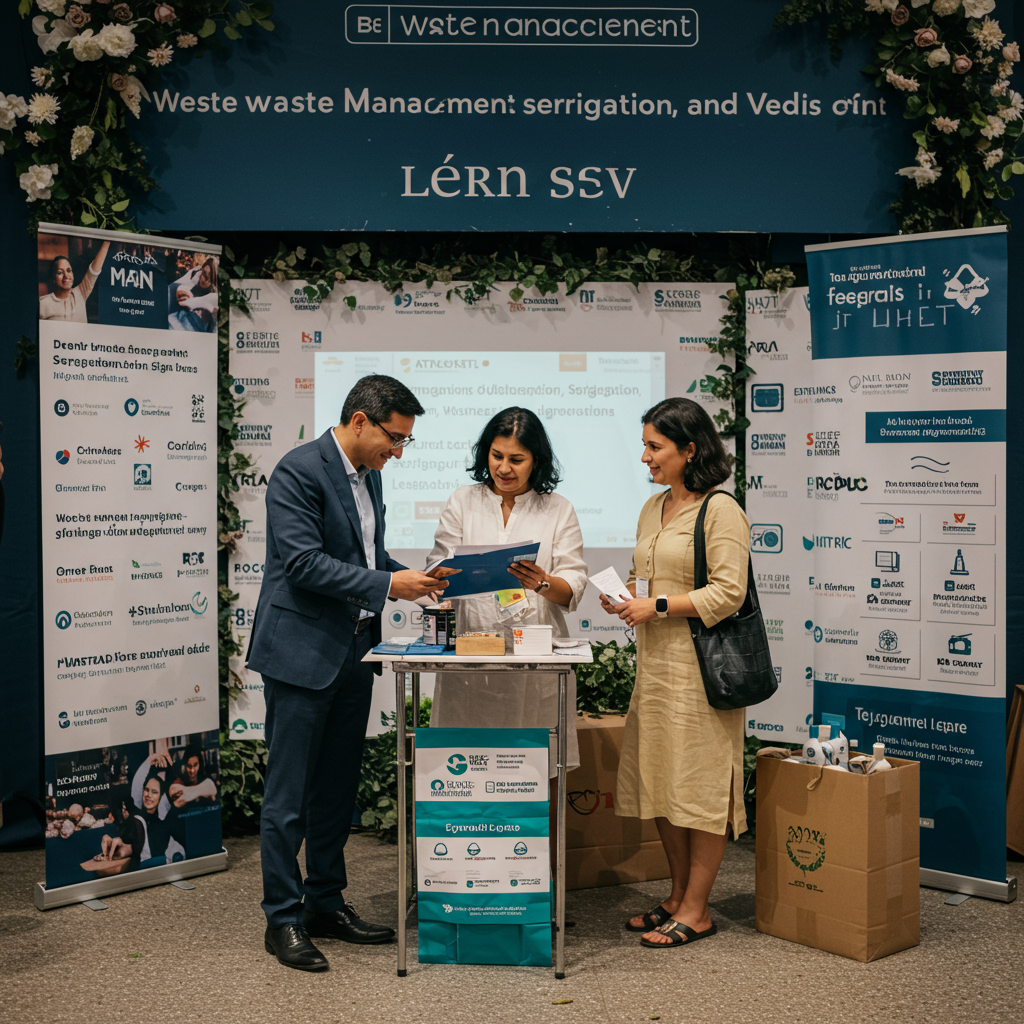
Event Waste Management: A Complete Guide to Segregation, Signage, and Suppliers
This article offers a comprehensive framework for event organizers looking to implement a robust and measurable sustainability strategy. We address event waste management from initial planning to post-event reporting, focusing on three key pillars: source segregation, effective communication and signage, and strategic supplier selection. The goal is to provide practical tools to reduce environmental impact, optimize operating costs, and enhance brand image. Through this approach, organizers can aim for ambitious KPIs such as achieving a diversion rate above 85%, keeping recycling stream contamination below 10%, and significantly increasing the Net Promoter Score (NPS) related to the perception of the event’s sustainability. This guide is aimed at event producers, sustainability managers, and operations directors who want to transform their events into circular economy models.
Introduction
Events, from massive music festivals to corporate conferences, are catalysts for connection and culture, but they also generate a significant environmental impact, primarily through waste production. Poor planning can result in tons of valuable materials ending up in landfills, with the consequent economic and reputational costs. Therefore, effective event waste management has become a fundamental pillar of modern production, not only as an ethical obligation, but also as a competitive advantage. Implementing a robust segregation system, supported by clear signage and collaboration with specialized suppliers, is crucial to minimizing the environmental footprint and aligning the event with the expectations of an increasingly environmentally conscious audience.
The methodology proposed in this guide is based on the Plan-Do-Check-Act (PDCA) continuous improvement cycle, adapted to the dynamic nature of event production. It focuses on establishing clear and measurable objectives from the outset. The Key Performance Indicators (KPIs) to be monitored include the diversion rate (percentage of waste diverted from landfill), the contamination rate per material flow (ideally less than 10%), the management cost per attendee (in €/person), and the associated reduction in carbon footprint. This data not only validates the success of the strategy but also provides a solid foundation for optimization in future editions.
 width=”1024″ height=”768″>
Vision, Values, and Proposal
Focus on Results and Measurement
Our vision is to transform the events industry into an engine of the circular economy, where the concept of “waste” is replaced by that of “resource.” This approach is based on the values of responsibility, efficiency, and innovation. We apply the Pareto principle (80/20) to prioritize actions: we focus on the 3-4 largest waste streams (e.g., beverage containers, organic waste, cardboard), which typically constitute more than 80% of the total generated. By effectively managing these flows, we achieve the greatest impact with a concentrated effort. Our technical standards are based on ISO 20121 for sustainability management in events and European directives on waste, guaranteeing a rigorous approach aligned with international best practices.
Value Proposition: Reduction of direct costs (landfill fees), revenue generation (sale of recyclable materials), brand strengthening, and regulatory compliance.
Quality Criteria: Target deviation rate > 90% (target “Zero Waste”), complete traceability reports for each waste stream, and a maximum deviation of 5% between the initial waste estimate and the final volume generated.
Strategic Decision Matrix:
High Impact / Low Effort: Implement a reusable cup system; Ban single-use plastics among food suppliers.
- High Impact / High Effort: Develop an on-site composting facility; audit all suppliers in the supply chain.
- Low Impact / Low Effort: Digitize the event program; use recyclable signage.
- Low Impact / High Effort: Attempt to recycle complex materials without a specialized manager.
Services, Profiles, and Performance
Portfolio and Professional Profiles
We offer a suite of modular services designed to cover the entire lifecycle of event waste management, from strategic consulting to on-site implementation. These services are implemented by a team of specialized professionals, each with a defined role to ensure maximum efficiency.
Audit and Strategic Planning: Preliminary analysis to estimate waste volumes and types, and design of a customized Sustainability Plan. Profile: Event Sustainability Consultant.
Supplier and Infrastructure Management: Selection, negotiation, and coordination with waste management companies, container suppliers, and signage providers. Profile: Sustainable Logistics Coordinator.
On-site Implementation and Supervision: Deployment of recycling stations, management of the “Green Team” (volunteers or trained staff), and active supervision during the event. Profile: Field Supervisor / Green Team Leader.
Training and Communication: Training of event staff, volunteers, and suppliers, and development of communication campaigns for attendees. Profile: Environmental Communication Specialist.
- Monitoring and Reporting: Data collection, weighing of fractions, KPI analysis, and preparation of the final impact report. Profile: Sustainability Analyst.
Operational Process
- Phase 1: Diagnosis (Pre-event – 12 weeks): Conducting a waste audit based on historical data or estimates. KPI: Waste estimate accuracy > 90%.
- Phase 2: Planning (Pre-event – 10 weeks): Designing the operational plan, including a map of collection points, defining flows, and selecting suppliers. KPI: Plan approved by all parties (venue, promoter) 8 weeks before the event.Phase 3: Implementation (Event Week): Infrastructure setup, final staff training, and briefing with all departments. KPI: 100% of stations operational 12 hours before doors open.
Phase 4: Execution and Monitoring (During the Event): Active supervision, incident resolution, and real-time contamination audits. KPI: Average response time to a full container < 20 minutes.
Phase 5: Dismantling and Collection (Post-event + 24 hours): Safe removal of all waste, ensuring proper final segregation at the triage center. KPI: Event venue cleared of waste within 24 hours.
Phase 6: Analysis and Report (Post-event + 2 weeks): Final weighing, KPI calculation, and delivery of the sustainability report. KPI: Report delivery within 10 business days.
Tables and examples
Save 2.5 tons of PET. Cup return rate > 95%. Attendee NPS +10 points.Achieve an 85% diversion rate.Percentage of waste (by weight) diverted from landfill; Contamination rate of waste streams.Hire a waste management company for the organic fraction (composting). Implement 4-stream stations (organic, packaging, paper, other waste). Train a “Green Team”.Less than 15% of total waste sent to landfill. Organic contamination rate < 5%.Optimize waste management costs.Total cost per attendee (€); Revenue from the sale of recyclable materials (€)Negotiate rates with waste management companies based on material purity. Compact cardboard and plastic on-site to reduce transport costs.Cost per attendee < €2.50. Cover 15% of operating costs with material sales.
| Objective | Indicators (KPIs) | Key Actions | Expected Result |
|---|---|---|---|
| Reduce single-use plastic by 90% | Number of plastic bottles avoided; Return rate of reusable cups | Implement a reusable cup system with a €1 deposit. Prohibit the sale of water in plastic bottles. Install drinking water fountains. |

Representation, Campaigns and/or Production
Professional Development and Management
The flawless execution of a waste management plan requires rigorous logistical and administrative coordination. This encompasses everything from obtaining the necessary permits for waste transport and treatment to contract management with a network of reliable suppliers. A detailed execution schedule is developed and integrated with the overall event production plan, ensuring that container deployment, staff training, and scheduled collections do not interfere with other critical operations such as stage setup or sound checks.
Coordination with the venue manager is essential to approve the locations of large-volume containers (compactors, hooklift containers) and access routes for collection trucks.
Documentation and Permits Checklist:
Contracts signed with all waste management companies.
Accreditation of waste management companies as authorized carriers and processors.
Occupational Risk Prevention Plan for waste management personnel.
Supplier’s liability insurance policy.
Logistics and Suppliers Checklist:
Confirmation of container and bag stock 15 days before the event.
Delivery and collection schedule confirmed in writing.
Contingency plan for overflows: emergency contact 24-hour service and extra collection service agreement in less than 3 hours.
- Clear communication protocol between the cleaning team, the “Green Team,” and the event control center (e.g., dedicated radio channel).
- Contingency Checklist:
- Pre-agreed secondary supplier in case of primary supplier failure.
- Emergency stock of bags, gloves, and basic signage.
- Action plan for adverse weather conditions (wind, heavy rain) that may affect waste and containers.

Content and/or Media that Convert
Messages, Formats, and Conversions: The Key to Signage
In the context of waste management at events, “content that converts” is the signage and communication that leads an attendee to deposit their waste in the correct container. Conversion is, therefore, a physical action. To achieve high conversion rates (low pollution), messages must be extremely clear, concise, and visual. The “hook” is a large, recognizable pictogram. The “Call to Action” (CTA) is a direct instruction such as “CONTAINERS ONLY”. A/B testing can be carried out in different areas of the event: in one area, signage with only pictograms; in another, with pictograms and detailed text. The conversion metric is the purity rate of the containers in each area, measured through quick visual audits every hour.
- Phase 1: Content Strategy Definition (Responsible: Communications Specialist). Identify the 4-5 key waste types and the main messages. Develop a visual style guide (colors, typography, iconography) consistent with the event’s brand.
- Phase 2: Design and Production (Responsible: Graphic Designer). Create the final artwork for all signage: container fronts, information posters, messages for giant screens, etc. Send to production using durable and, if possible, reusable or recyclable materials.
Phase 3: Deployment and Placement (Responsible: Logistics Coordinator). Install all signage at strategic points. Verify that it is visible from a distance, well-lit, and unobstructed. Signage must always be above the container, at eye level.
Phase 4: Activation and Reinforcement (Responsible: Green Team Leader). The “Green Team” acts as a human reinforcement of the visual content. Its mission is to interact amicably with the public, answer questions, and correct segregation errors in an educational manner.
Phase 5: Measurement and Optimization (Responsible: Sustainability Analyst). Conduct visual audits of containers to measure the “conversion rate.” Gather feedback from the “Green Team” on the most common questions from attendees to improve signage in future editions.

Training and employability
Demand-oriented catalog
Training is the cornerstone of the entire operational strategy. A well-trained team, from cleaning staff to “Green Team” volunteers, is exponentially more effective. We offer a catalog of short, practical training modules, designed to be delivered just before the event and tailored to the specific needs of each role.
Module 1: Fundamentals of Waste Management at Events (60 min). Aimed at all event staff. Covers the importance of sustainability, the specific objectives of the event, and the waste hierarchy (Reduce, Reuse, Recycle).
Module 2: Advanced Identification and Segregation (90 min). A hands-on workshop for the “Green Team” and supervisors. Real samples of the waste that will be generated are used to practice proper sorting and learn to identify the main contaminants.
Module 3: Assertive Communication with the Public (45 min). Focused on the “Green Team.” Techniques for interacting with attendees in a positive and educational way, how to resolve common doubts, and how to manage minor conflict situations.
Module 4: Health and Safety Protocols (30 min). Mandatory for all personnel handling waste. Use of Personal Protective Equipment (PPE), load handling, and protocol in case of finding hazardous objects (syringes, broken glass).
Module 5: Container Auditing and Monitoring (60 min). For supervisors and analysts. Methodology for conducting quick visual inspections, estimating contamination percentages, and recording data consistently.
Methodology
Our training methodology is eminently practical (“learning by doing”). Assessment is carried out using simple rubrics during practical exercises (e.g., a simulation of sorting a bag of mixed waste). Following the event, a debriefing is held with the entire team to share lessons learned. Participation in these programs not only improves event performance but also provides participants with transferable skills and knowledge, enhancing their employability in the growing green economy and sustainable events sector. Certificates of participation can be issued to accredit the acquired skills.
Operational Processes and Quality Standards
From Request to Execution
A standardized process guarantees consistency and quality of service, minimizing errors and ensuring that client objectives are met. Our operational pipeline is divided into five clear phases, with defined deliverables and acceptance criteria for each.
Diagnosis and Proposal Phase:
Input: Request for information from the event organizer.
Process: Collection of key data (capacity, type of event, duration, venue layout). Preparation of a waste generation estimate and a preliminary audit. Design of a customized strategy.
- Deliverable: Detailed technical and economic proposal, including objectives, KPIs, timeline, and budget.
- Acceptance Criteria: Client’s signature on the proposal and contract.
- Pre-production Phase:
- Input: Signed contract.
- Process: Kick-off meeting. Detailed logistical planning. Supplier contracting. Signage design and production. Training Plan.
- Deliverable: Sustainability Operational Plan (final version), including maps, schedules, and protocols.
- Acceptance Criteria: Approval of the Operational Plan by the client and the venue.
- Execution Phase:
- Entry: Start of event setup.
- Process: Infrastructure deployment. On-site staff training. Continuous supervision throughout the entire event, including setup, opening to the public, and dismantling.
- Deliverable: Daily status reports (incident reports, estimated volumes, etc.).
- Acceptance Criteria: Compliance with operational SLAs (response times, cleanliness levels).
- Closing and Measurement Phase:
- Entry: Event completion.
- Process: Removal of all infrastructure. Coordination of final waste transport. Obtaining official weighing tickets from each waste manager.Deliverable: Official weighing tickets for each waste fraction.
Acceptance Criteria: Reconciliation of weights with supplier estimates and reports.
Reporting and Optimization Phase:
Input: All collected data.
Process: Data analysis. Calculation of final KPIs (deviation rate, carbon footprint, etc.). Preparation of the impact report. Post-mortem meeting with the client.
- Deliverable: Final Sustainability Report and/or Impact Certificate.
- Acceptance Criteria: Client acceptance of the report and final payment.
-
Quality Control
- Defined Roles: The Sustainability Supervisor is ultimately responsible for the quality of the on-site service. The “Green Team” Leaders oversee specific areas and report directly to the supervisor.
- Escalation Protocol: An incident (e.g., severe contamination of a container) is detected by an operator, reported to the Team Leader, who evaluates it and, if necessary, escalates it to the Supervisor for a decision (e.g., treat the contents as “waste”).
- Acceptance Indicators and SLAs:
- Public container fill level never exceeding 80%.
- Contamination rate in recycling streams not exceeding 15% in any audit.
- Sustainability Supervisor availability: 100% during public opening hours.
ImplementationShift reports, Incident logHourly contamination audits. Overflow response times < 20 min.Risk: Mass contamination of a stream (e.g., liquids in the paper container). Mitigation: Reinforce the presence of the “Green Team” in the area, improve real-time signage, and, if necessary, change the container opening to reduce the likelihood of errors.
Process Control, Risk, and SLA Table Mitigation Process Phase Key Deliverables Quality Control Indicators Potential Risks and Mitigation Actions Pre-production Final Operational Plan, Container Map, Supplier Contracts Formal approval of the plan by the facility. 100% of suppliers with signed contracts 4 weeks prior. Risk: The main supplier fails. Mitigation: Have a secondary provider with a pre-agreement for service. Closure and Measurement Official weigh tickets Deviation between estimated and actual weight < 10%. 100% of tickets received within 72 hours. Risk: The manager does not provide itemized weights, only a total weight. Mitigation: Require itemized weights per contract and specify a penalty for non-compliance. Conduct your own weighing with a portable scale as a backup.
Application Cases and Scenarios
Case 1: Indie Music Festival (25,000 attendees, 3 days)
Challenge: The festival had a history of low recycling rates (approx. 35%) and high post-event cleanup costs. The main problem was the massive volume of single-use plastic beer cups and the contamination of recycling bins with food scraps.
Solution Implemented: A reusable cup system was introduced with a €1.50 deposit. The waste stations were completely redesigned, switching to a 4-strat model: Organic (for food scraps and napkins), Packaging (cans, plastic bottles, cartons), Paper/Cardboard, and Other Waste. A team of 40 volunteers (“Green Guardians”) was formed to rotate through the stations and assist the public. All food stalls were required to use only compostable tableware (plates, cutlery).
Solution Implemented:
Results and KPIs:
- Deviation Rate: Reached 82%, an increase of 47 percentage points.
- Waste Reduction: More than 150,000 single-use cups were avoided.
- Cup Return Rate: 96%. Revenue from unreturned cups covered 120% of the service cost.
- Management Cost: Reduced from €3.10 to €2.40 per attendee thanks to lower landfill fees and revenue from the sale of materials.
- NPS: Post-event surveys showed an 18-point improvement in the perception of the festival’s sustainability.
Case 2: International Technology Congress (3,000 attendees, 2 days)
Challenge: The event generated a large amount of paper and cardboard waste (brochures, programs, stand packaging) and significant food waste during coffee breaks and catered lunches.
Implemented Solution: Almost all printed materials were eliminated, migrating to an event app for the program, maps, and speaker information. We worked with the catering company to adjust food quantities based on real-time registration and to serve buffet-style with ceramic plates and metal cutlery. An agreement was established with a local food bank to collect any unserved food. Dedicated recycling points for badges and lanyards were set up at the end of the event.
Results and KPIs:
- Paper Reduction: More than 500 kg of paper were avoided.
- Organic Waste: 350 kg of food were donated, equivalent to approximately 800 servings. El desperdicio alimentario se redujo en un 60% respecto a la edición anterior.
- Tasa de recuperación de acreditaciones: 88% de las acreditaciones fueron devueltas para su reutilización o reciclaje.
- ROI: El ahorro en costes de impresión y gestión de residuos (22.000 €) superó con creces la inversión en la app del evento y la logística de donación de alimentos.
Caso 3: Boda Sostenible (150 invitados, 1 día)
Desafío: Aunque de menor escala, las bodas pueden generar una cantidad desproporcionada de residuos, especialmente de decoración de un solo uso, flores y desperdicio de comida del banquete. El cliente quería un evento con una huella de carbono mínima.
Solución Implementada: Se trabajó con los novios y el wedding planner desde la fase de diseño. Se optó por decoración alquilada o elementos naturales que pudieran ser compostados. Las flores se donaron a una residencia de ancianos local al día siguiente. Se diseñó un menú con productos de kilómetro cero y se pidió a los invitados que confirmaran su elección de plato principal con antelación para minimizar el desperdicio. Se instaló una pequeña pero clara estación de reciclaje con tres fracciones (orgánico, vidrio, resto) y se dio una breve y amena explicación a los invitados al inicio del banquete.
Resultados y KPIs:
- Generación de “Resto”: Solo se generó una bolsa de 50 litros de residuos no reciclables para 150 personas.
- Tasa de desvío: Se estimó una tasa de desvío superior al 95%.
- Impacto social: La donación de flores y el excedente de tarta tuvo una acogida muy positiva.
- ADR (Average Daily Rate): Aunque no es una métrica directa, el enfoque en la sostenibilidad se convirtió en un punto de venta único que permitió al wedding planner diferenciarse y atraer a clientes con valores similares.
Guías paso a paso y plantillas
Guía 1: Cómo auditar y estimar la generación de residuos
- Paso 1: Recopilar Datos Base. Reúne la siguiente información: número de asistentes esperado, duración del evento en horas, número y tipo de puestos de comida/bebida, si se utilizará menaje desechable o reutilizable, y si hay datos de residuos de ediciones anteriores.
- Paso 2: Usar Coeficientes de Generación. Si no hay datos históricos, utiliza estándares de la industria. Por ejemplo: un asistente a un festival de música puede generar entre 0,5 y 0,8 kg de residuos por día. Un asistente a un congreso, entre 0,8 y 1,2 kg (más papel y residuos de catering).
- Paso 3: Estimar la Generación Total. Multiplica el número de asistentes por el coeficiente de generación y por los días de duración. Ejemplo: 10.000 asistentes * 0,6 kg/asistente/día * 2 días = 12.000 kg (12 toneladas) de residuos totales estimados.
- Paso 4: Caracterizar los Flujos. Desglosa el total estimado en porcentajes por tipo de residuo. Ejemplo para un festival: 40% Orgánico, 30% Envases, 10% Papel/Cartón, 20% Resto. Esto te dará un peso estimado por cada flujo que necesitarás gestionar.
- Paso 5: Identificar Puntos Calientes. Sobre un plano del recinto, marca las áreas de mayor generación de residuos: zonas de restauración, barras, zonas de descanso, backstage. Esto determinará dónde necesitas más contenedores y personal.
- Paso 6: Dimensionar la Infraestructura. Con los pesos estimados por flujo y las ubicaciones, calcula el número y tamaño de los contenedores necesarios. Consulta a tu proveedor de residuos, que te ayudará a traducir los kg a volumen (m³).
- Checklist Final:
- ¿Has incluido los residuos generados durante el montaje y desmontaje? (pueden ser hasta el 30% del total).
- ¿Has considerado los residuos de los proveedores y expositores?
- ¿Tu estimación diferencia entre residuos de la zona pública y de backstage?
Guía 2: Diseño de una estación de residuos perfecta
- Paso 1: Agrupar siempre. Nunca coloques un contenedor solitario. Siempre agrupa todos los flujos que ofrezcas (p. ej., Orgánico + Envases + Resto) en una única “estación”. Esto obliga al usuario a tomar una decisión.
- Paso 2: Código de colores intuitivo. Usa los colores estándar siempre que sea posible: Marrón para orgánico, Amarillo para envases, Azul para papel, Gris/Negro para resto. La consistencia es clave en todo el recinto.
- Paso 3: Señalización jerárquica. La señalización debe tener tres niveles de información:
- Nivel 1 (Distancia): Un cartel o bandera grande y visible desde lejos que diga “PUNTO DE RECICLAJE”.
- Nivel 2 (Aproximación): Justo encima de la estación, un cartel grande que muestre claramente los flujos disponibles con sus respectivos colores y un pictograma grande.
- Nivel 3 (Decisión): En el frontal de cada contenedor, un cartel con el nombre del flujo, el pictograma, y una lista visual (fotos o dibujos) de 3-4 ejemplos de lo que SÍ va y 1-2 ejemplos de lo que NO va.
- Paso 4: Diseño de las aberturas. Adapta la forma de la boca del contenedor al residuo que esperas. Una ranura estrecha para el papel, una abertura redonda para latas y botellas. Esto dificulta físicamente el error.
- Paso 5: Ubicación estratégica. Coloca las estaciones en los flujos naturales de gente: cerca de las zonas de comida y bebida, en las salidas de las zonas de conciertos, y en los caminos principales. La distancia entre estaciones no debería ser superior a 50 metros.
Guía 3: Checklist para contratar al proveedor de residuos ideal
- Paso 1: Verificar la Acreditación Legal. Solicita los documentos que le acreditan como Gestor y Transportista Autorizado de Residuos en la comunidad autónoma correspondiente. Sin esto, no puedes contratarle.
- Paso 2: Exigir Experiencia en Eventos. Pide referencias de otros eventos de tamaño y características similares en los que hayan trabajado. Habla con esos organizadores si es posible. Un evento no es lo mismo que un servicio industrial o municipal.
- Paso 3: Evaluar la Capacidad de Trazabilidad. Pregunta si pueden garantizar la trazabilidad de cada flujo de residuo y proporcionar certificados de tratamiento final. ¿Pueden darte los pesos desglosados por cada material o solo un total? La transparencia es crucial.
- Paso 4: Analizar su Flexibilidad y Plan de Contingencia. ¿Qué ocurre si el evento genera más residuos de los estimados? ¿Tienen capacidad de hacer recogidas de emergencia? ¿Cuál es su tiempo de respuesta? ¿Operan 24 horas durante el evento?
- Paso 5: Revisar la Calidad de su Infraestructura. Pide fotos de sus contenedores. ¿Están en buen estado, limpios, bien señalizados de origen? ¿Ofrecen diferentes tipos y tamaños para adaptarse a tus necesidades?
- Paso 6: Comparar el Modelo de Precios. No te fijes solo en el precio final. Analiza cómo está estructurado: ¿hay un coste fijo de alquiler? ¿El precio es por peso, por volumen o por recogida? ¿Hay costes ocultos? Un modelo basado en el peso de cada fracción puede incentivar una mejor segregación.
Recursos internos y externos (sin enlaces)
Recursos internos
- Plantilla de Plan de Gestión de Residuos para Eventos (formato .docx)
- Catálogo de Diseños de Señalética Estándar (formato .pdf)
- Manual de Formación para el Green Team (formato .pdf)
- Hoja de Cálculo para la Estimación y Seguimiento de Residuos (formato .xlsx)
- Checklist de Auditoría de Sostenibilidad de Proveedores (formato .docx)
Recursos externos de referencia
- Norma ISO 20121: Sistemas de gestión de la sostenibilidad para eventos.
- Directiva (UE) 2018/851 del Parlamento Europeo y del Consejo por la que se modifica la Directiva 2008/98/CE sobre los residuos.
- Guías de Buenas Prácticas de la organización A Greener Festival.
- Informes y guías del Programa de las Naciones Unidas para el Medio Ambiente (PNUMA) sobre plásticos de un solo uso.
- Legislación local y autonómica sobre gestión de residuos.
Preguntas frecuentes
¿Cuál es el coste medio de una gestión de residuos en eventos profesional?
El coste varía significativamente según el tamaño, tipo y ubicación del evento, así como el nivel de ambición de los objetivos de sostenibilidad. Como referencia, puede oscilar entre 1,50 € y 4,00 € por asistente. Un plan básico de reciclaje estará en el rango bajo, mientras que una estrategia de “Cero Residuos” con compostaje, equipos dedicados y sistemas de reutilización estará en el rango alto. Sin embargo, una buena gestión puede generar ahorros (menores tasas de vertedero) e ingresos (venta de materiales) que compensen parte de la inversión.
¿Cómo puedo convencer a los asistentes para que separen sus residuos correctamente?
La clave es hacerlo fácil e intuitivo. La estrategia se basa en tres pilares: 1) Infraestructura conveniente: estaciones de reciclaje bien ubicadas, limpias y nunca desbordadas. 2) Comunicación clara: señalética con pictogramas grandes, códigos de color y mensajes sencillos. 3) Intervención humana: la presencia de un “Green Team” amable y proactivo que educa y ayuda al público es el factor que marca la mayor diferencia.
¿Qué es más importante: reducir, reutilizar o reciclar?
La jerarquía de residuos es clara y fundamental. La prioridad número uno es siempre reducir: evitar que el residuo se genere en primer lugar (p. ej., eliminando los folletos de papel). La segunda opción es reutilizar: dar múltiples usos a un mismo objeto (p. ej., el sistema de vasos reutilizables). El reciclaje es la tercera opción, para aquellos residuos que no se han podido evitar ni reutilizar. Es una buena solución, pero consume energía y recursos. La peor opción es siempre el vertedero.
¿Es realmente posible organizar un evento de “Cero Residuos”?
Sí, es un objetivo alcanzable, aunque muy ambicioso. La definición estándar de “Cero Residuos” (Zero Waste) aceptada internacionalmente es lograr una tasa de desvío de vertedero igual o superior al 90%. Requiere una planificación integral desde las primeras fases del diseño del evento, un control estricto sobre todos los materiales que entran en el recinto y una colaboración total de todos los implicados: organizadores, proveedores, artistas y asistentes.
¿Qué hago con los residuos orgánicos si mi municipio no tiene recogida selectiva?
Los residuos orgánicos (restos de comida) son uno de los mayores retos, pero también una gran oportunidad. Si no existe un servicio municipal, es necesario contratar a un gestor de residuos privado que ofrezca servicios de compostaje industrial o digestión anaeróbica. Esta gestión es crucial, ya que los residuos orgánicos en el vertedero generan metano, un potente gas de efecto invernadero. Prohibir que los puestos de comida vendan en envases no compostables simplifica enormemente esta recogida.
Conclusión y llamada a la acción
La gestión de residuos en eventos ha trascendido la simple limpieza para convertirse en un componente estratégico que define la viabilidad, reputación y legado de cualquier producción. Como hemos visto, un enfoque estructurado en la segregación, una señalización inteligente y la elección de proveedores competentes no solo minimiza el impacto ambiental, sino que también optimiza costes, refuerza la imagen de marca y genera una conexión más profunda con un público que valora la sostenibilidad. Alcanzar KPIs como una tasa de desvío del 85% o reducir el coste por asistente por debajo de 2,50 € es perfectamente factible con la planificación adecuada. El camino hacia eventos de “Cero Residuos” no es una utopía, sino una hoja de ruta operativa que cualquier organizador puede empezar a seguir.
No esperes a que la regulación o la presión del público te obliguen a actuar. Toma la iniciativa y convierte la sostenibilidad en una de las señas de identidad de tu evento. El primer paso es entender tu punto de partida. Te invitamos a contactarnos para realizar una auditoría preliminar sin compromiso. Descubre el potencial oculto en tus residuos y empieza a diseñar un evento más limpio, eficiente e inspirador hoy mismo.
Glosario
- Tasa de Desvío (Diversion Rate)
- El porcentaje de la totalidad de los residuos generados por un evento que se desvían del destino final de vertedero. Se calcula como (Peso total de residuos – Peso de residuos a vertedero) / Peso total de residuos * 100.
- Contaminación de Flujo
- La presencia de materiales incorrectos en un contenedor de recogida selectiva (p. ej., restos de comida en el contenedor de papel). Reduce la calidad y el valor del material reciclable y puede hacer que todo el lote sea rechazado.
- Economía Circular
- Un modelo de producción y consumo que implica compartir, alquilar, reutilizar, reparar, renovar y reciclar materiales y productos existentes durante el mayor tiempo posible. El objetivo es que los recursos se mantengan en la economía el mayor tiempo posible y se minimice la generación de residuos.
- ISO 20121
- Norma internacional que especifica los requisitos para un sistema de gestión de la sostenibilidad de eventos. Proporciona un marco para que los eventos sean gestionados de forma sostenible, abordando aspectos económicos, ambientales y sociales.
- Green Team (Equipo Verde)
- Grupo de personal o voluntarios específicamente formados y dedicados a las tareas de sostenibilidad durante un evento. Sus funciones incluyen la gestión de las estaciones de reciclaje, la educación del público y la monitorización de los flujos de residuos.
- Upcycling (Suprarreciclaje)
- El proceso de transformar subproductos, residuos, productos inútiles o no deseados en nuevos materiales o productos de mayor calidad, valor artístico o medioambiental.
Internal links
- Click here👉 https://uk.esinev.education/masters/
- Click here👉 https://uk.esinev.education/diplomates/
External links
- Princeton University: https://www.princeton.edu
- Massachusetts Institute of Technology (MIT): https://www.mit.edu
- Harvard University: https://www.harvard.edu
- Stanford University: https://www.stanford.edu
- University of Pennsylvania: https://www.upenn.edu